Anonymous ICLR 2027 Submission
When Motion Misleads
Causal-Role-Aware Motion-Turbulence Disentanglement for Turbulent Infrared Video Super-Resolution
Motivation
Real motion helps; turbulence pseudo-motion corrupts.
In open-air infrared videos, observed displacement mixes coherent object or camera motion with random refractive perturbations. Treating both as a single motion signal propagates distortion and destabilizes temporal reconstruction.
- 01
Physics-grounded factorization. LMTD uses thermo-radiative motion coherence to separate mixed temporal dynamics into object-motion and turbulence components.
- 02
Role-specific restoration. TCLR suppresses local turbulence perturbations, while MCTE exploits coherent motion for temporal detail enhancement.
- 03
Reliability-guided generation. Motion reliability regulates one-step restoration to preserve constructive cues without amplifying uncertain pseudo-motion.
Restoration results
Recovering stable structure from turbulent infrared video
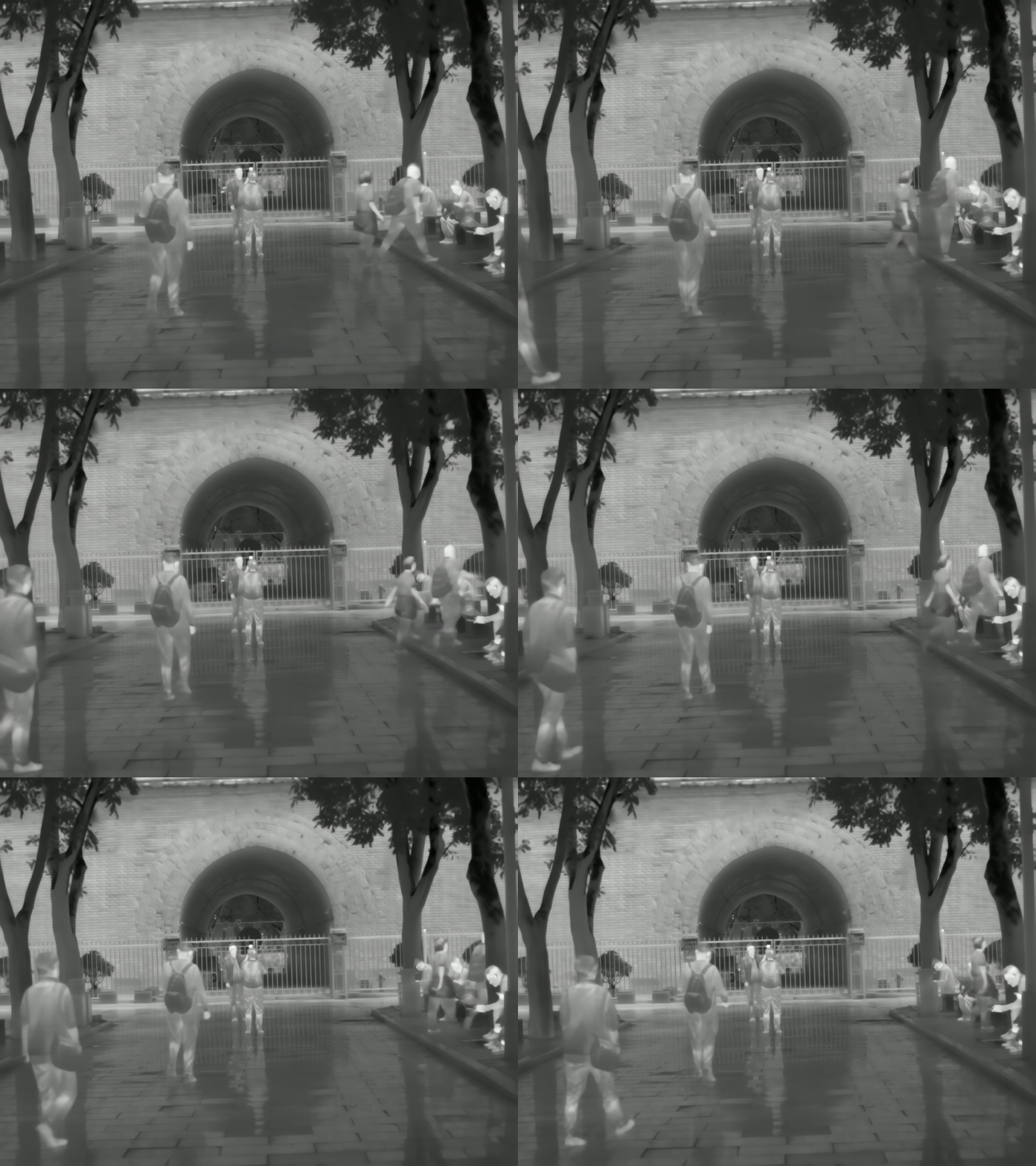
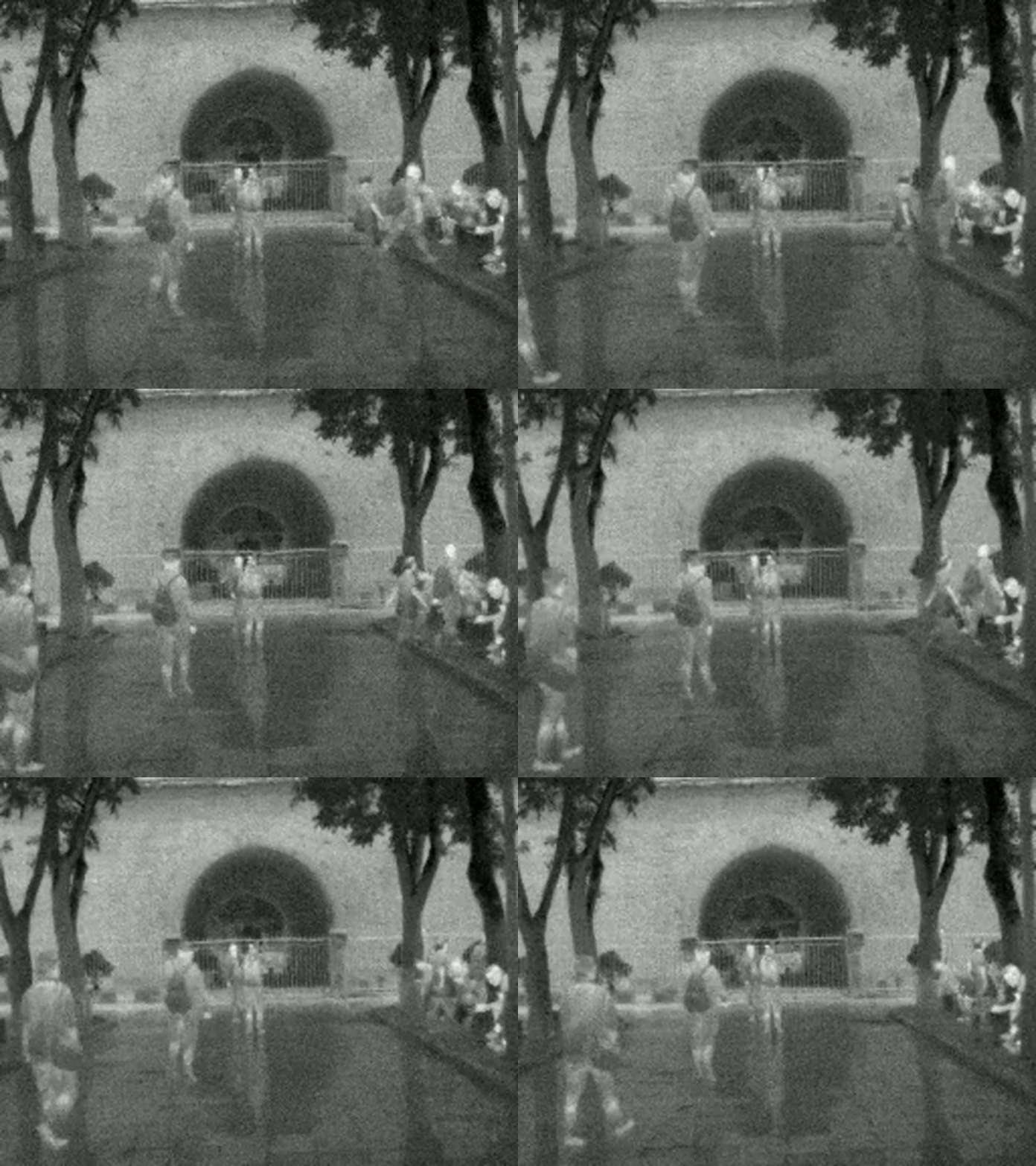
Drag the divider to compare the turbulent low-resolution input with CAMO. Use the arrows to inspect different scenes.
Method comparison
Animated comparisons under the same degradation
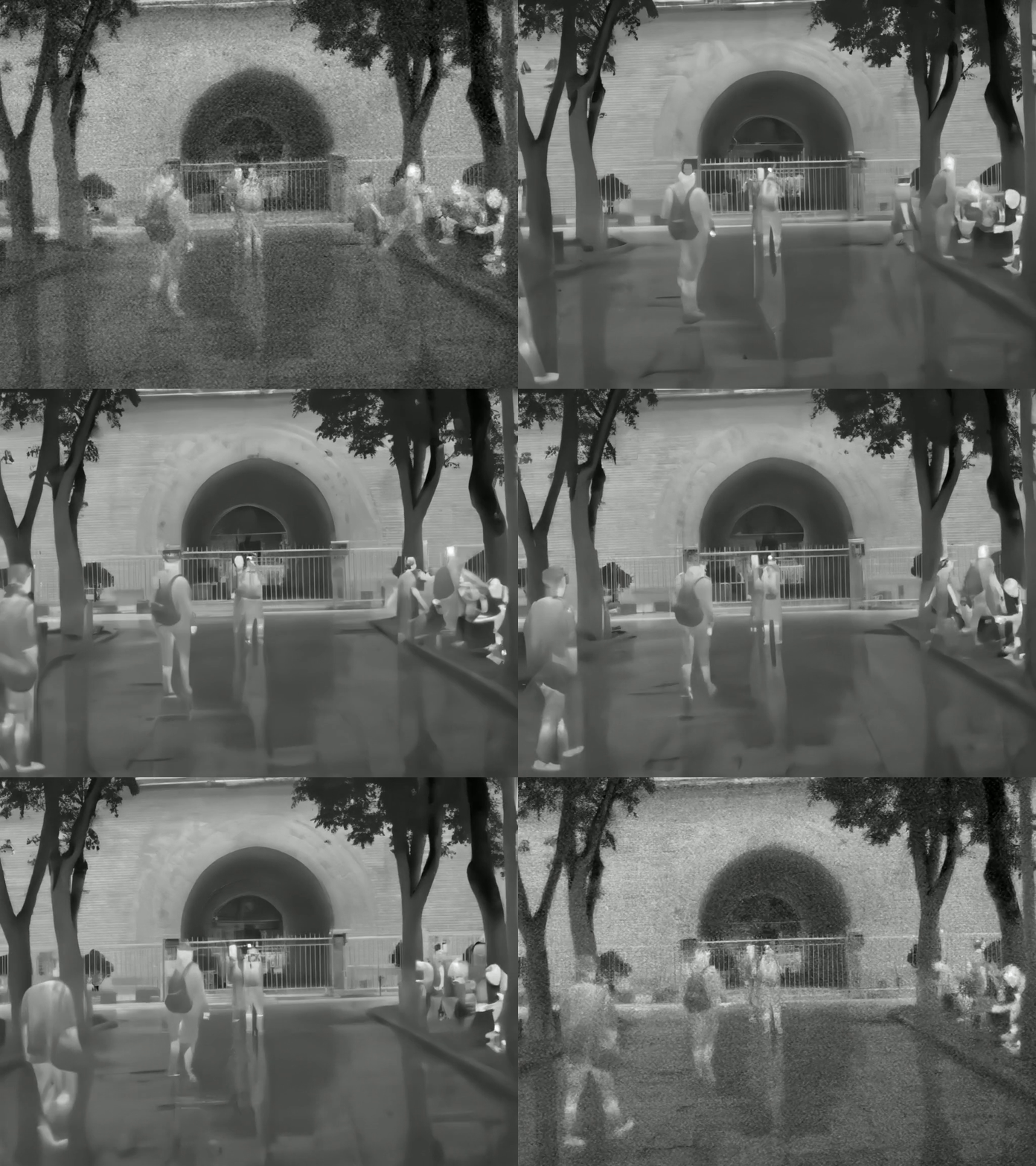
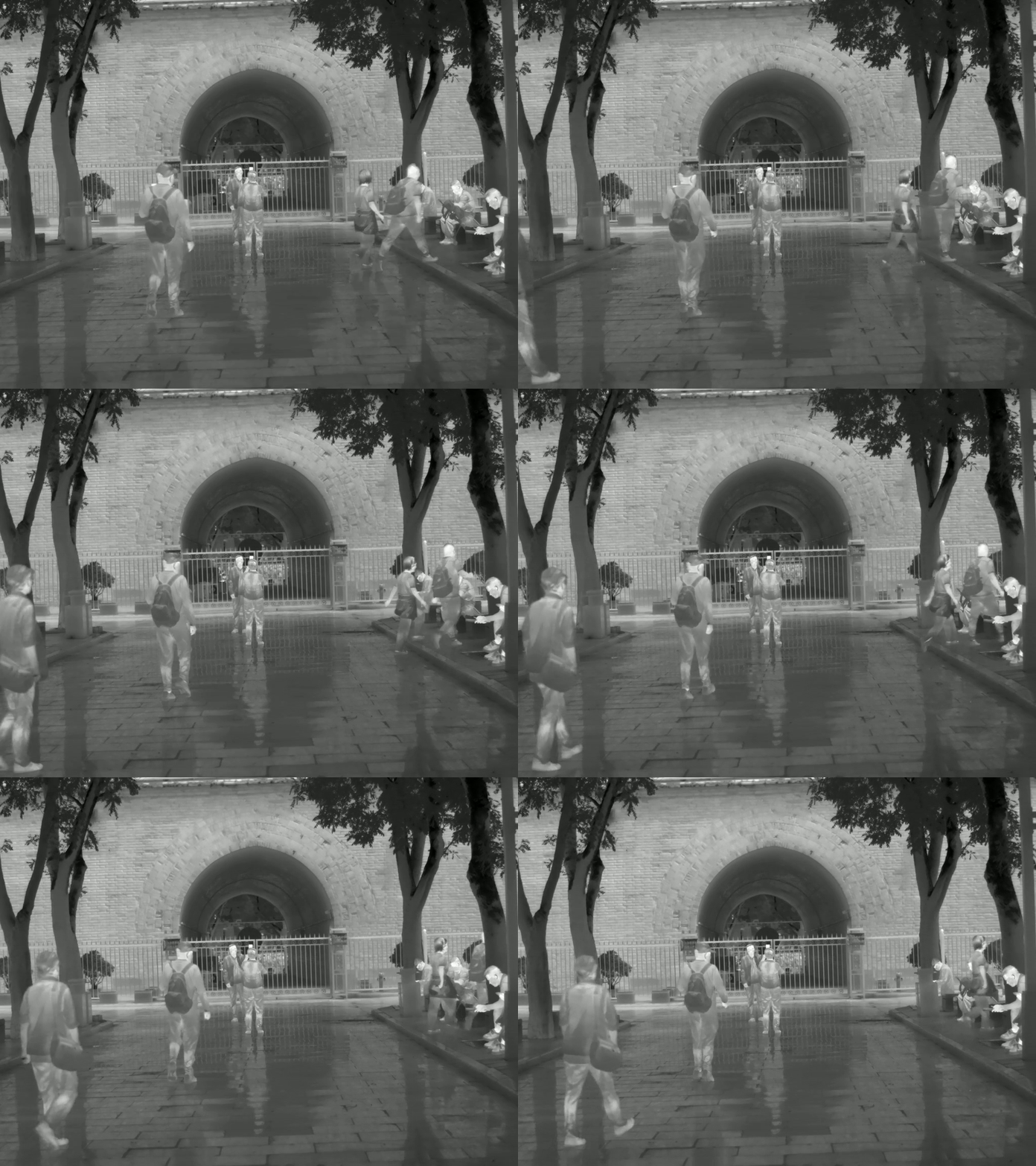
Compare temporal behavior against representative VSR and turbulence-mitigation baselines.
Efficiency
High video quality without iterative sampling
CAMO performs restoration in a single generative step and reaches 2.32 FPS in the reported setting. It attains the highest FasterVQA score among the compared methods while remaining faster than the evaluated diffusion-based alternatives.
- 2.32
- FPS
- 1-step
- Restoration
Method
Causal-role-aware motion-turbulence disentanglement
CAMO first factorizes mixed temporal dynamics, then uses the resulting components at different stages of the one-step restoration pipeline.
Disentanglement analysis
Separating structured motion from stochastic perturbations
Across different scenes, the object-motion component preserves coherent structures and boundaries, whereas the turbulence component captures spatially irregular residual perturbations.
Benchmark results
Quantitative and qualitative comparisons
CAMO is evaluated on FLIR-IVSR and M3FD using restoration fidelity, perceptual quality, and temporal quality metrics.